as others are. What's the goal of this McCain ad? Couldn't it just as easily, with a few tweaks, be an Obama ad instead? What am I missing?
Friday, October 31, 2008


Wednesday, October 29, 2008
One Small Chunk of Data
Speaking to my point about the "undemocratic" nature of the Electoral College, via Matt Ygelsias:
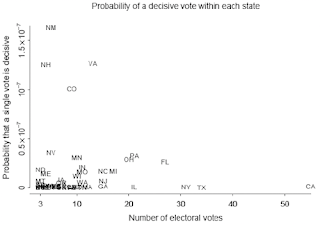
UPDATE: The larger picture:
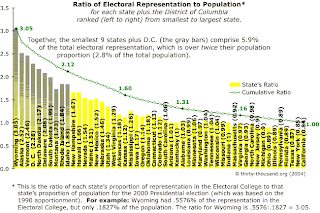

UPDATE: The larger picture:

Monday, October 27, 2008
Saturday, October 25, 2008

Friday, October 24, 2008
Election Night Update
Okay, this will shock you all, I realize, but I have run into a Gigantor-sized bureaucratic fol-de-rol in trying to get something set up for election night. So how's this for an alternative plan: I'll end my Tuesday night class a bit early (we'll set a time this coming week), and we can head over to my apartment (about ten blocks north). I've two TVs in separate rooms, so we can bounce back and forth. And if you can find someplace not terribly expensive for Kosher food, we'll order in, and it will be on me. I'll ask you guys to be responsible for beverages, and paper/plastic cups and plates (or we can pick them up on the way). This is not ideal, I know, but it seems our best alternative without too much mishigos (spelling?). How's this sound? (Brief reply in comments).
"The Weirdness of Campaign Reporting"
Newsweek's Michael Hastings via Ezra Klein. With just a little Hunter S. Thompson.
Bias?

From a new study by the Project for Excellence in Journalism:
- Coverage of Obama began in the negative after the conventions, but the tone switched with the changing direction of the polls. The most positive stories about him were those that were most political -- focused on polling, the electoral map and tactics.
- For McCain, coverage began positively, but turned sharply negative with McCain's reaction to the crisis in the financial markets. As he took increasingly bold steps in an effort to reverse the direction of the polls, the coverage only worsened. Attempts to turn the dialogue away from the economy through attacks on Obama's character did hurt Obama's media coverage, but McCain's was even more negative.
- Coverage of Palin, in the end, was more negative than positive. In all, 39% of Palin stories carried a negative tone, while 28% were positive and 33% were neutral. Contrary to what some critics have suggested, little of the coverage was about Palin's personal life (5%).
- Democratic vice presidential nominee Joe Biden was nearly the invisible man. His coverage enjoyed just one large moment, the vice presidential debate, which also provided the only positive or neutral contribution to his coverage. Aside from that week, the limited coverage he did receive was far more negative than Palin's, and nearly as negative as McCain's.
- The economy was hardly a singular lens through which the media perceived the race. Though it was the No. 1 campaign topic overall, in five out of the six weeks analyzed, other topics drew more media attention, and the economy accounted for not much more of the campaign newshole (18%) than did assessments of the candidates in the four debates (17%).
- Horse race reporting, once again, made up the majority of coverage, but less so than earlier in the contest or in previous elections. Since the conventions ended, 53% of the newshole studied has focused on political matters, particularly tactics, strategy and polling -- twice the coverage focused on policy (20%). The focus on tactics and horse race increased in the last three weeks as both campaigns became more negative in their rhetoric.
Monday, October 20, 2008
Deep Geek Blogging
Pull up your socks -- I'm back. I'll pop in and comment on your newly-posted bloggy goodness within the next few days, but meanwhile, take a look at this nice, very different kind of fact-checking, via the political scientists at The Monkey Cage. Fun fact: one Dutch graduate student offered me an exegesis on how Heroes offers a keen window into American culture. Hmmmm. . . .
Tuesday, October 14, 2008
Blog Pause
Okay, I'm off. Back next week. Posting will be light, at best, though I will try to pop in periodically. Meanwhile, play nice, keep reading, keep watching, keep thinking, and post wise, insightful, professionally-formatted things. I'll probably not see the final debate, so tell me what I missed, especially as it relates to the media coverage.
"The Irrational Electorate"
Larry Bartels, reviewing questions and literature that should now be familiar. Worth your time.
Sunday, October 12, 2008
Friday, October 10, 2008
A Whole 'Nother Kind of Debate
On Wednesday, October 29, 7:30 PM, in Weissberg Commons, the YC and SCW Political Science Society will host a debate with representatives from the McCain and Obama campaigns. I will serve as moderator. Questions will be drawn from those submitted by students: send yours (YU students only, please) to: yuelections@gmail.com.
I'd be especially grateful for some questions that stand a chance of provoking more than stump-speech responses or sound bite answers. And those that go beyond the very narrow range of matters subject to public discourse so far. And, of course, questions about media and the campaigns.
Pass along the e-mail address to your friends, as well.
I'd be especially grateful for some questions that stand a chance of provoking more than stump-speech responses or sound bite answers. And those that go beyond the very narrow range of matters subject to public discourse so far. And, of course, questions about media and the campaigns.
Pass along the e-mail address to your friends, as well.
Thursday, October 09, 2008
"The Haunting of the Present by the Past"
Trailer for new BBC documentary, "The American Future: A History"
Wednesday, October 08, 2008
Tuesday, October 07, 2008
Effete, Pointy-Headed Intellectuals at Work
Non-media edition. Berkeley economist Brad De Long, prepping for class, modeling what Hofstadter meant by "intellectual":
Now I have to think about my Great Depression lectures: what have I learned from the financial crisis of the past fourteen months that should change what I think about the Great Depression? And how should I change what I think?
Subscribe to:
Posts (Atom)


